The Blood War: The Eternal Conflict Between Demons and Devils in Dungeons & Dragons
Introduction
In the vast multiverse of Dungeons & Dragons, there exists a conflict so ancient, so brutal, and so all-consuming that it has shaped the very fabric of reality itself. This is the Blood War — the eternal struggle between demons and devils, chaos and law, fought across the infinite layers of the Lower Planes. For players and Dungeon Masters in the Netherlands and around the world, understanding this conflict opens up countless possibilities for epic campaigns, moral dilemmas, and unforgettable adventures.
The Blood War is not merely a backdrop; it is the engine that drives the cosmic balance of the D&D multiverse . First introduced in 1991 through the Monstrous Compendium: Outer Planes Appendix for Advanced Dungeons & Dragons 2nd Edition, this conflict has become a cornerstone of D&D lore, particularly within the beloved Planescape campaign setting .
What is the Blood War?
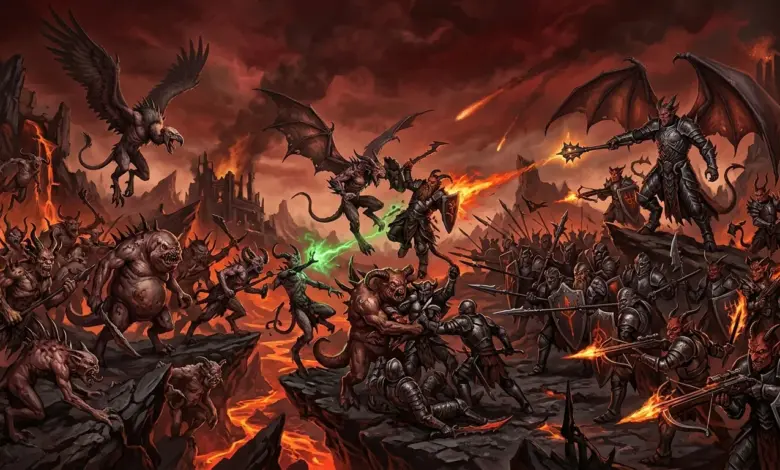
The Blood War is an apocalyptic conflict that has raged for eons between the fiendish races of the Lower Planes — the demons of the Abyss and the devils of the Nine Hells . It is a war of annihilation, fought not for territory or resources, but for the very definition of evil itself.
At its core, the Blood War represents the fundamental opposition between two philosophical extremes:
- Demons (Tanar’ri): Chaotic Evil beings who believe evil is pointless if it lacks passion and spontaneity
- Devils (Baatezu): Lawful Evil beings who argue that evil is meaningless without long-term planning and structured hierarchy
This philosophical divide runs so deep that it transcends mere hatred — it represents a cosmic incompatibility that ensures neither side can ever truly coexist with the other .
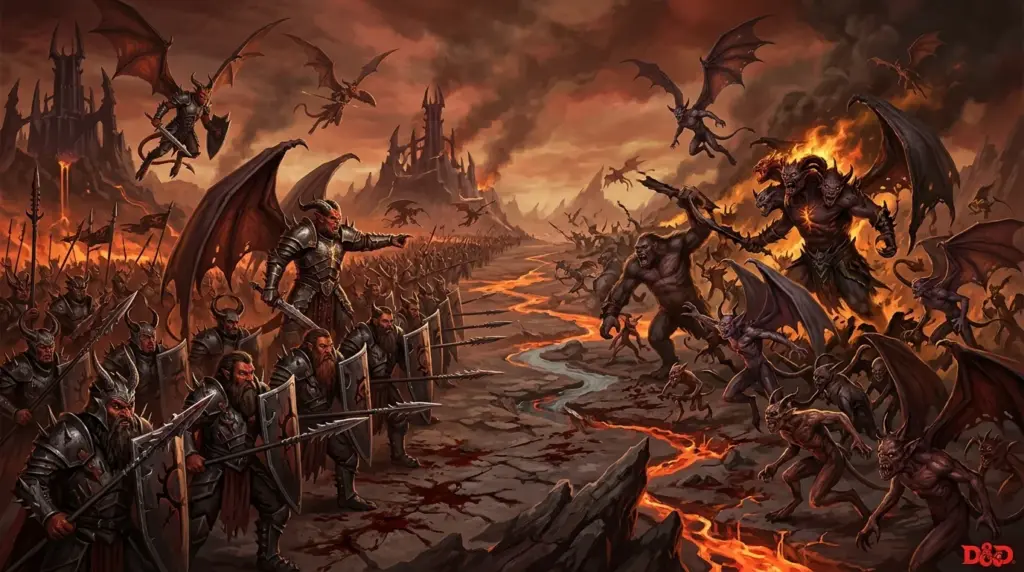
Combatants of the Blood War
Table 1: Demons vs. Devils — Key Differences
| Feature | Demons (Tanar’ri) | Devils (Baatezu) |
|---|---|---|
| Alignment | Chaotic Evil | Lawful Evil |
| Home Plane | The Abyss (infinite layers) | The Nine Hells of Baator (9 layers) |
| Command Structure | Disorganized, warring factions | Rigid military hierarchy |
| Numbers | Vast, potentially infinite | Fewer, but highly disciplined |
| Tactics | Overwhelming force, terror | Strategy, manipulation, ambushes |
| Infantry Power | CR 8+ for basic units | CR 3+ for basic units |
| Soul Acquisition | Steal souls from the Wall of the Faithless | Make deals and contracts with mortals |
| Key Leaders | Demogorgon, Orcus, Graz’zt | Asmodeus, The Dark Eight, Bel |
| Permanent Death | Only possible within the Abyss | Only possible within the Nine Hells |
The Forces of Chaos — Demons
The demons emerge from the infinite layers of the Abyss, a plane of endless, shifting horror where new layers are constantly being created . Unlike the structured hierarchy of Hell, demon society is a chaotic free-for-all where the strong dominate the weak, and betrayal is expected. This internal conflict prevents them from ever fully uniting against their devilish foes.
Demon princes like Demogorgon, Orcus, and Graz’zt spend as much time fighting each other as they do fighting devils . Yet their sheer numbers are terrifying — the Abyss constantly spawns new demons, making their armies seem limitless .
The Legions of Order — Devils
In contrast, the devils of the Nine Hells operate with ruthless efficiency. Under the supreme command of Asmodeus, the Lord of the Nine Hells, devil society is a brutal meritocracy where every fiend knows its exact place in the hierarchy .
The war effort is coordinated by the Dark Eight — a coven of pit fiend generals who reside on Nessus, the ninth layer of Hell . Bel, the Lord of Avernus (the first layer of Hell), serves as the frontline commander, personally overseeing the defense of Hell’s borders .
The Mercenaries — Yugoloths
No discussion of the Blood War is complete without mentioning the yugoloths (also known as daemons). These neutral evil fiends serve as mercenaries for both sides, selling their services to whichever faction offers the better deal . Some legends suggest the yugoloths secretly orchestrated the entire conflict as an experiment into the nature of evil .
The River Styx — The Highway of War
The River Styx winds through multiple Lower Planes, including both the Abyss and the Nine Hells . This treacherous waterway serves as the primary route for demonic invasions, as demons can travel along its banks or sail its waters to reach Hell’s borders.
The first layer of Hell, Avernus, bears the brunt of these assaults. This blasted wasteland is permanently scarred by the endless warfare, featuring:
- Trenches and fortifications built from the bones of fallen fiends
- Siege towers carved from glacial ice
- Battlefields littered with the wreckage of infernal war machines
- Rivers of blood and fields of corpses stretching to the horizon
Why Hasn’t the Blood War Ended?
Despite the endless carnage, neither side has achieved lasting victory. This stalemate exists for several key reasons :
The Numbers Problem
Demons vastly outnumber devils, as the Abyss generates new demons constantly. However, their chaotic nature means they cannot effectively coordinate large-scale operations. They fight among themselves, pursue personal glory over strategic objectives, and lack the discipline to maintain prolonged campaigns .
The Discipline Advantage
Devils fight as a unified army with clear chains of command. They can execute complex strategies, maintain supply lines, and adapt to changing battlefield conditions. However, they have far fewer soldiers and must carefully allocate their limited resources .
The Soul Economy
Both sides require mortal souls to replenish their ranks. Devils obtain souls through infernal contracts and deals — a slow but steady process. Demons steal souls from various sources, including the Wall of the Faithless, but this is unreliable and dangerous .
Internal Conflicts
The greatest powers of both planes rarely participate directly in the Blood War. Asmodeus hoards his strength within his fortress of Malsheem, preparing for a cataclysmic battle he believes will dwarf the Blood War itself. The demon princes remain preoccupied with their endless internal struggles for dominance .
The Cosmic Importance of Stalemate
Here is the terrifying truth that archmages like Mordenkainen understand: the Blood War must never end .
If the demons were to win, they would overrun the Nine Hells and grow so powerful that no force could stop them from consuming all of existence. The Abyss would spread like an infection across every plane, dragging reality itself into eternal chaos.
If the devils were to win, Asmodeus would impose the rigid bureaucracy of Hell upon all creation . Freedom, spontaneity, and hope would be replaced by absolute order — a tyranny so complete that even the gods could not oppose it.
Even the celestials of the Upper Planes secretly support the Blood War, providing weapons and aid to whichever side appears to be losing . They know that a divided evil is manageable; a unified evil is apocalyptic.
Running Blood War Campaigns in the Netherlands
For DMs in the Netherlands looking to incorporate the Blood War into their campaigns, here are several adventure frameworks adapted from expert recommendations :
Low-Level: Lost Souls on the Styx
Players awaken as souls who have escaped from a ferry crossing the River Styx. Their ferryman was killed in a Blood War skirmish, giving them a second chance to save their souls. They must navigate extraplanar battlefields, make deals with yugoloth mercenaries, and find a way back to the Material Plane before they are recaptured.
Mid-Level: The Mournland Incursion
Using Eberron’s Mournland as inspiration, the Blood War spills into the Material Plane through a tear in reality . Demons and devils battle across the Dutch countryside, forcing players to choose sides or try to drive both factions back to the Lower Planes.
High-Level: Shifting the Balance
The archmage Mordenkainen personally approaches the party with a mission: assassinate a powerful archdevil or demon prince to prevent one side from gaining an overwhelming advantage . Success could save the multiverse, but the players must venture deep into enemy territory, facing dangers that would destroy lesser heroes.
The Blood War Across D&D Editions
| Edition | Status of the Blood War |
|---|---|
| AD&D 2nd Edition (Planescape) | Central focus; massive shadow over all of existence |
| 3rd/3.5 Edition | Still canonical but less emphasized |
| 4th Edition | Changed to hot/cold cycles; Asmodeus steals Abyss shard |
| 5th Edition | Restored to classic interpretation in Mordenkainen’s Tome of Foes |
Frequently Asked Questions
Q: What started the Blood War?
A: No one knows for certain. The yugoloths claim it was their experiment into evil. Devils believe it began when angels transformed into fiends to fight chaos. The truth is lost to the ages, forgotten even by the oldest fiends .
Q: Can demons and devils ever work together?
A: Almost never. Their philosophical differences run too deep. However, rare exceptions exist, particularly when facing a common threat that endangers both factions .
Q: Why don’t the angels and good gods just destroy both sides?
A: The celestials cannot defeat the unified forces of evil, and they understand that a stalemate is preferable to either side winning. They secretly manipulate the Blood War to maintain this balance .
Q: Can player characters truly affect the Blood War?
A: Yes, but usually on a local scale. Individual parties cannot end the war, but they can influence key battles, assassinate important commanders, or prevent one side from gaining a critical advantage .
Q: Is the Blood War present in all D&D settings?
A: Most official settings include the Blood War in some form. Eberron offers unique interpretations where the war might be fought within Khyber itself. Forgotten Realms follows standard cosmology .
Q: What role do souls play in the Blood War?
A: Mortal souls are the currency of the Blood War. Both sides need souls to create new fiends and fuel their war machines, which is why they aggressively corrupt mortals .
Conclusion
The Blood War is more than just lore — it is the shadow that falls across every D&D campaign, whether players realize it or not. Every devil deal offered, every demon cult discovered, every corrupted soul saved or lost ripples outward into this eternal conflict.
For Dungeon Masters in the Netherlands and beyond, the Blood War offers limitless storytelling potential. It can serve as the backdrop for epic high-level campaigns where players shape the fate of the multiverse, or as a distant horror whose agents occasionally slip through to threaten unsuspecting villages.
Understanding the Blood War means understanding the fundamental tension between order and chaos, law and freedom, tyranny and destruction — a tension that lies at the heart of countless adventures waiting to be told.