2026: The Year Survival Games Went Nuclear
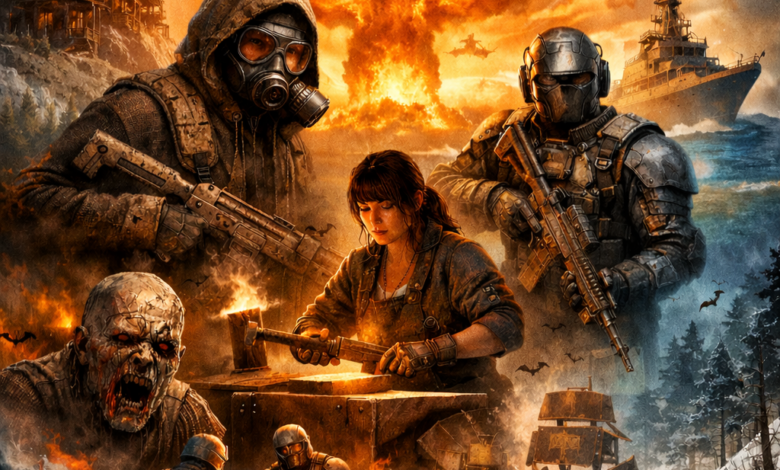
If you’ve spent years waking up on digital beaches with nothing but a rock and bad luck, 2026 feels like a reward. This isn’t just another year of small updates and recycled mechanics. This is the year survival games leveled up — massively.
We’re not talking about minor balance tweaks or cosmetic DLC packs. We’re seeing full releases after long Early Access journeys. Genre-defining system overhauls. Multiplayer expansions that change how we survive together. Developers aren’t polishing the formula anymore — they’re tearing it apart and rebuilding it.
After more than a decade of surviving harsh virtual worlds — starving in frozen forests, getting raided at 3 a.m., and losing bases I spent weeks building — I can confidently say: something feels different this year.
Let’s break down the heavy hitters, the breakout newcomers, and the wildcards that could reshape survival gaming forever.
The Titans Evolving Beyond Recognition
Enshrouded 1.0: From Early Access Gem to Full Survival Powerhouse
Enshrouded has quietly become one of the most ambitious survival games in recent memory. After two years of Early Access, its full 1.0 release in Autumn 2026 isn’t just a milestone — it’s a transformation.
For those unfamiliar, Enshrouded blends deep base-building with high-risk exploration zones covered in deadly fog. The “Shroud” forces players to manage time carefully. Venture too deep without preparation, and the environment itself becomes your enemy.
That mechanic alone created tension. But 1.0 adds systems that could redefine long-term survival gameplay.
The new Adventure Sharing system allows players to explore friends’ worlds even when they’re offline. Imagine logging in and finding your castle upgraded, or discovering someone left rare materials in your vault. It creates a living world without demanding synchronized schedules.
Then there’s the Logic System — essentially survival gaming’s answer to advanced automation. Think pressure plates triggering trap systems, automated drawbridges, conveyor-fed crafting pipelines, and layered defensive networks. Builders are about to go wild.
Verticality is expanding too. Floating islands — long visible but inaccessible — will finally open up. Sky bases connected by gliders and zip-lines might become the new endgame meta.
And with PlayStation 5 and Xbox releases coming post-launch, Enshrouded is about to reach an entirely new audience. Couch co-op survival? Finally.
If your first base in Enshrouded was a wooden shack barely holding back wolves, 1.0 might see you constructing sky fortresses powered by logic circuits and guarded by automated ballista towers.
Rust’s Naval Update: Survival at Sea
Rust has always been brutal. Spawn naked. Get hit with a rock. Respawn. Repeat.
Its February 2026 Naval Update didn’t just add boats — it rewrote the meta.
For the first time, survival doesn’t have to be landlocked. Players can now construct modular ships with engines, cannons, storage decks, and defensive structures. Your base can float. It can move. It can disappear beyond the horizon.
The addition of the Deep Sea biome changed exploration completely. Ghost ships, rare loot zones, procedurally generated islands, and even sea monsters now exist beyond traditional map borders.
Ocean survival offers something Rust hasn’t before: strategic mobility. Solo players who once struggled against massive clans now have viable options. A fast boat and fishing setup can sustain you far from the toxic spawn beaches.
Of course, danger followed. Helicopters patrol coastal waters. NPCs adapt. Naval battles between player factions have become common. Entire floating cities now drift across servers.
Rust didn’t soften its brutality — it just expanded the battlefield.
Project Zomboid Build 42: The Apocalypse Gets Deeper
Project Zomboid has always been the thinking person’s zombie survival game. No flashy killstreaks. No heroic power fantasies. Just slow decay, creeping infection, and constant dread.
Build 42, expected to stabilize fully in 2026, is the biggest leap the game has ever made.
The lighting overhaul alone transforms Knox County. Night feels dangerous again. Shadows matter. Flashlights flicker. The horror is back in full force.
Weather is no longer cosmetic. Rain soaks clothing, increasing hypothermia risk. Storms alter travel routes. Temperature management becomes critical.
Animals have entered the ecosystem. Hunting deer, raising chickens, sustainable farming — long-term survival now feels realistic rather than repetitive.
The crafting overhaul pushes things further. When industrial supplies run out, you can forge tools from scrap metal, craft pottery for storage, even produce alcohol for medical use.
Project Zomboid isn’t about flashy action. It’s about survival systems so deep they feel frighteningly real.
If you want hardcore apocalypse immersion, this remains unmatched.
New Blood Changing the Game
StarRupture: Factory Survival Meets Alien Horror
Creepy Jar surprised everyone by launching StarRupture into Early Access early in 2026. Known for the jungle realism of Green Hell, they pivoted hard into sci-fi survival — and it worked.
You crash-land on a hostile alien planet filled with insect swarms and catastrophic solar storms called “Ruptura flares.” These flares can destroy unshielded structures instantly.
So you don’t just build a base. You build intelligently.
Generators need shielding. Automation is critical. Defense systems must handle wave-based bug assaults that feel ripped from Starship Troopers.
StarRupture blends:
- Survival crafting
- Factory automation
- Tower defense mechanics
- Cooperative multiplayer
Up to four players can coordinate roles — one managing power grids, another handling turret networks, others gathering materials or fighting swarms.
It feels like survival gaming evolved into something industrial and strategic.
And at its Early Access price point, it’s already delivering absurd value.
Subnautica 2: Surviving the Depths Together
The original Subnautica remains one of the greatest survival games ever created. Its sense of isolation was its strength — alone in alien oceans, descending into terrifying depths.
Subnautica 2 is taking a different approach.
Built from the ground up for co-op, players can now explore with friends. Share oxygen. Coordinate submarine expeditions. Build underwater bases collaboratively.
The new planet promises deeper abyssal zones and smarter Leviathan predators. Rumors suggest pack-hunting behaviors, meaning even advanced players won’t feel safe.
Multiplayer changes everything. Survival becomes shared tension rather than solitary dread.
If done right, this sequel could define the genre for years.
The Wildcards with Massive Potential
Dune: Awakening Expands
Already thriving on PC, Dune: Awakening is heading to consoles in late 2026.
Set in the harsh deserts of Arrakis, it combines MMO-scale persistent worlds with survival mechanics. Harvesting spice, avoiding sandworms, piloting ornithopters, and engaging in faction warfare creates a hybrid experience.
Few survival games operate at this scale.
If the console audience embraces it, this could become one of the biggest survival ecosystems ever created.
Blackfrost: The Long Dark Evolves
The Long Dark mastered environmental survival — no monsters needed. Just cold, hunger, and isolation.
Blackfrost, its sequel, aims to introduce cooperative survival while maintaining that quiet intensity.
Balancing co-op without ruining the meditative tone will be challenging. But if successful, it could redefine realistic survival gaming.
Light No Fire: The Ambitious Dream
Hello Games is promising something nearly impossible: an Earth-sized procedural fantasy world blending exploration, dragons, and survival systems.
After redeeming No Man’s Sky through relentless updates, the studio has earned cautious optimism.
If Light No Fire launches strong and receives long-term support, it could become a landmark survival experience.
Why 2026 Feels Different
This year isn’t about cloning Minecraft or copying Rust’s formula.
It’s about evolution.
We’re seeing:
- Naval survival warfare
- Automation systems in fantasy worlds
- Deep factory-survival hybrids
- Fully integrated co-op systems
- Expanding cross-platform accessibility
Survival games are no longer niche punishment simulators. They’re complex ecosystems with layered mechanics and broad appeal.
And perhaps most importantly, developers are respecting players’ intelligence. They’re adding depth rather than simplifying systems.
The Survival Genre Has Grown Up
For years, survival games felt experimental. Early Access dominated the space. Ideas were ambitious but unfinished.
Now, we’re seeing refinement.
The technology has matured. Player bases are massive. Live-service models fund long-term development.
2026 might be remembered as the year survival games stopped being a subgenre and became a pillar of modern gaming.
For veterans who’ve survived countless digital winters, ocean raids, and zombie sieges, this is the golden era.